F. Lanoy, E.M.H. White, B. Schäfer, B. Gorr, M.C. Galetz
International Journal of Refractory Metals and Hard Materials 139 (2026), 107821, DOI: 10.1016/j.ijrmhm.2026.107821
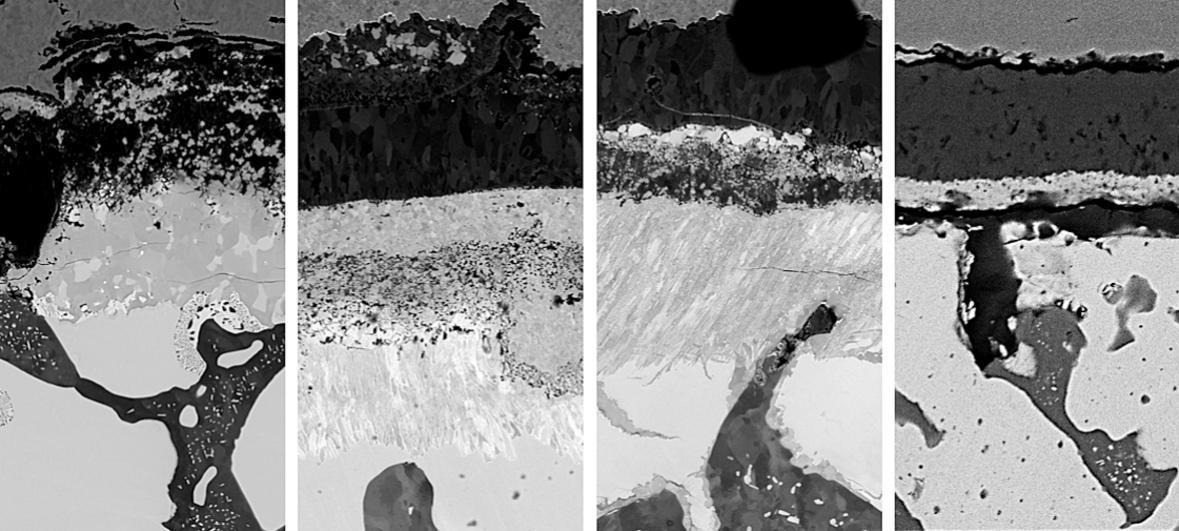
The development of novel structural materials for aggressive high-temperature environments requires enhanced oxidation resistance. In this work, small additions of Re, W and Cu to Cr-20 at.% Ta were investigated for their effects on oxidation at 1000 °C in a controlled, nitrogen-free, low oxygen atmosphere. Thermogravimetric analysis showed that both Re and Cu modifications significantly reduced the parabolic oxidation rate constant by more than 50% compared to the unmodified alloy. Re enhanced resistance through Cr site substitution in the tantalate subscale, reducing Cr supply to the outer chromia scale. Cu showed a similar rate constant through an initially thicker chromia scale leading to early formation of a continuous, thin CrTa₂O₆ layer, which then acted as an effective diffusion barrier for Cr outward diffusion. The W addition slowed Cr outward diffusion in the A2 matrix and C14 intermetallic dendrites, resulting in a changed scale morphology, but an overall scale thickness that was comparable to the unmodified alloy.