D. Benitez, B. Kölsch, T. Blackburn, A. Knowles, K. Ma, M. Kerbstadt, E. White, M. Galetz, T. Pinomaa, L. Freimane, A. Laukkanen, M. Navas, R. Hernández
MRS Bulletin (2026), DOI: 10.1557/s43577-025-01049-9
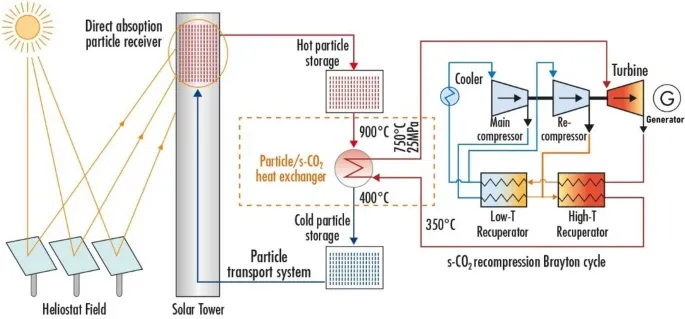
High-temperature heat exchangers for concentrated solar thermal systems operating at up to 750°C and 250 bar face challenges, including creep, oxidation, corrosion, thermal cycling, and particle-driven erosion. The COMPASsCO2 project explored Cr-based superalloys as cost-effective alternatives to conventional Ni-based alloys. Two novel material systems were developed: Cr-NiAl alloys with Fe additions that reached homogeneous microstructures and stable NiAl precipitates, enhancing high-temperature strength, and Cr-Si alloys showing exceptional hardness and erosion resistance. Although high ductile-to-brittle transition temperatures limited the use of Cr-Si as bulk materials, they proved effective as protective slurry coatings. A novel Cr-Si diffusion coating process was developed and validated through oxidation and erosion testing. Laboratory-scale testing under simulated conditions was supported by computational wear modeling, thermodynamic simulations, and machine-learning-based microstructural analysis. These findings highlight material solutions applicable to the particle/sCO2 use case and relevant to other high-temperature, chemically aggressive industrial environments.