K. Beck, T. König, C. Oskay, A.K. Czerny, F. Hinrichs, G. Winkens, A.S. Ulrich, M. Heilmaier, M.C. Galetz
High Temperature Corrosion of Materials 102 (2025), 27, DOI: 10.1007/s11085-025-10344-4
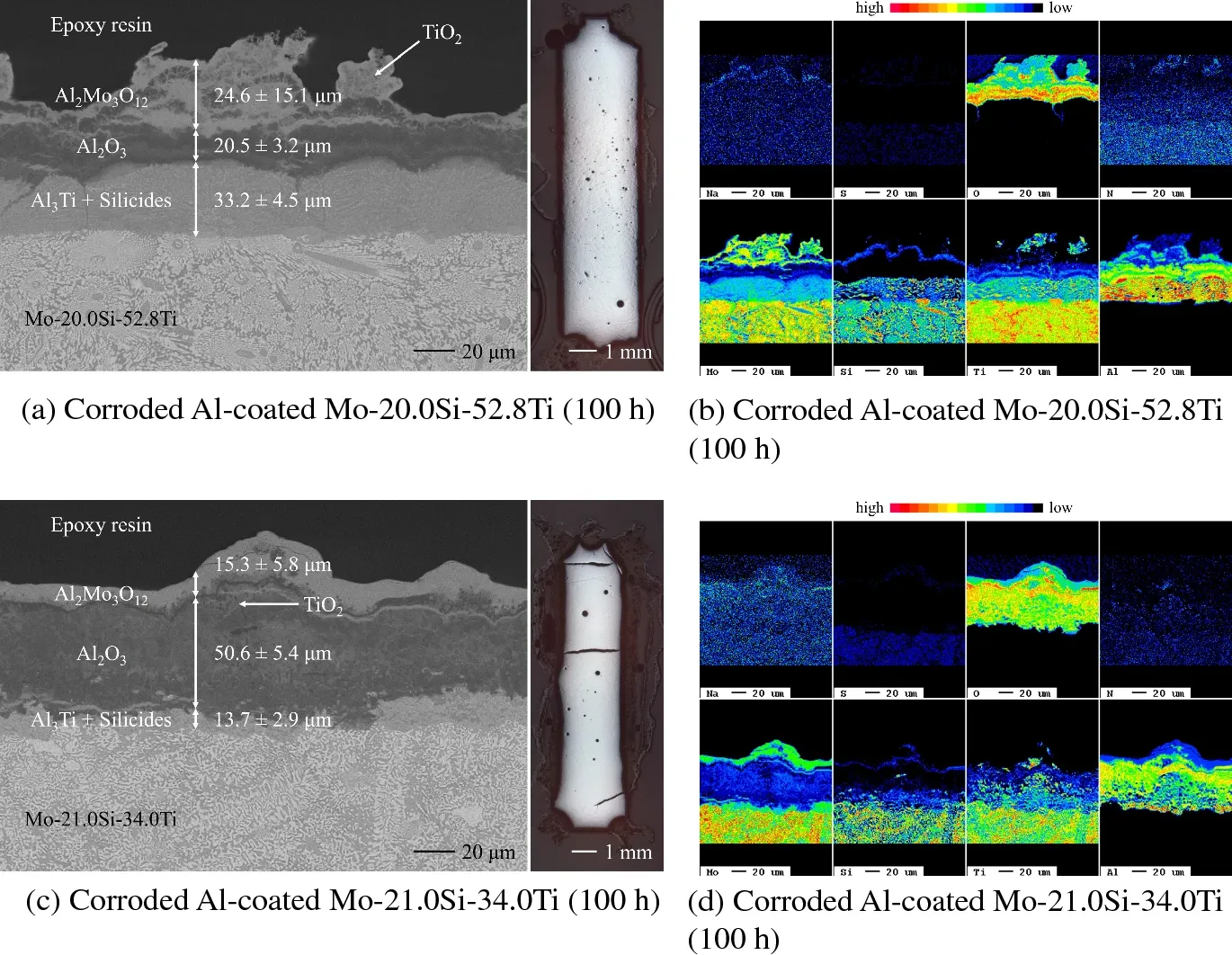
To understand the influence of Mo, Si, and Ti during aluminizing pack cementation processes of Mo-Si-Ti alloys, two ternary Mo-Si-Ti alloys (eutectic Mo-20.0Si-52.8Ti and eutectoid Mo-21.0Si-34.0Ti) were investigated and compared with pure Ti and Mo-40Ti (all in at.%). The coating formation mechanisms, phase composition, and microstructures of the different substrates were compared. Subsequently, the effect of the different elements on the oxidation behavior was evaluated, using thermogravimetric analysis at 700°C and 900°C for 100 h in synthetic air. In addition, the type I (900°C) and type II (700°C) hot corrosion behavior of the Al-coated Mo-Si-Ti alloys was investigated for 24 h and 100 h in synthetic air + 0.1% SO2. While the initial Al-rich coating phase was consumed or transformed at 700°C, it successfully facilitated the formation of a protective Al2O3 scale on the surface, even if the underlying reservoir was diminished. At 900°C, the Al coatings on both substrates failed, and a hot corrosion-induced pesting dominated. While Si generally has a positive effect on oxidation and hot corrosion resistance, the main impact of Mo is dictated by its evaporation, and Ti can lead to the formation of TiO2 as a mixed oxide with Al2O3.