| Laufzeit: |
01.03.2026 - 31.08.2028 |
|---|---|
| Partner: |
Karlsruher Institut für Technologie - KIT, AG. Prof. Dirk Holtmann Rheinisch-Westfälische Technische Hochschule Aachen - RWTH, Dr. Mojtaba Mohseni |
| Geldgeber: | Bundesministerium für Wirtschaft und Energie (BMWE) Förderkennzeichen: 01IF24602N |
| Bearbeiter: | Dr. Ida Dinges |
| Abteilung: | Chemische Technik |
| Teams: | Nachhaltige Elektrochemie |
„Tubuläre Gasdiffusions-Elektroden für die Bioökonomie“ (TuBi)
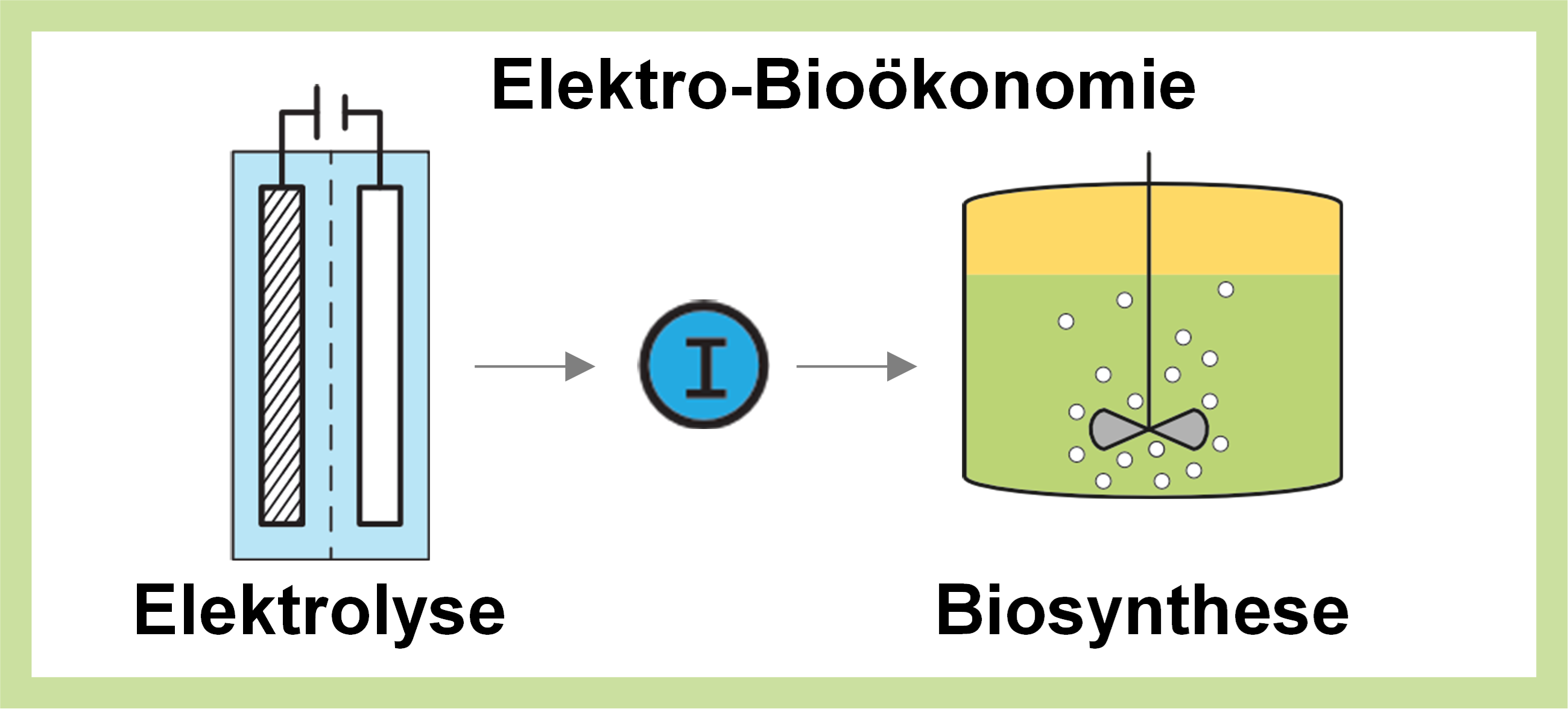
Der Übergang von fossilen zu erneuerbaren Rohstoffen und Energieträgern ist entscheidend für eine nachhaltige chemische Industrie. Die Elektro-Bioökonomie bietet durch die Kombination elektrochemischer und biotechnologischer Verfahren effiziente Lösungen für eine Defossilisierung. Dabei werden Zwischenprodukte wie beispielsweise Formiat oder Wasserstoffperoxid (H2O2) elektrochemisch hergestellt und anschließend in biotechnologischen Prozessen für wertschöpfende Synthesen weiterverwendet.
Zur Erreichung der Klimaneutralität rechnen die EU-Kommision und das BMWK mit einem erheblichen Wachstum der industriellen Bioökonomie bis 2045, was erhebliche Innovations- und Wachstumspotenziale für in der chemischen, biotechnologischen und angrenzenden Industrien bedeutet. Durch anwendungsnahe Entwicklungsarbeiten und den gezielten Technologietransfer leistet das Projekt „Tubuläre Gasdiffusions-Elektroden für die Bioökonomie“ (TuBi) einen wichtigen Beitrag zur Anschlussfähigkeit deutscher Unternehmen und KMU im Speziellen.
Ziel des Projektes „TuBi“ ist die dreidimensionale Integration von tubulären Gasdiffusionselektroden (GDE) in biologische Reaktorsysteme. Die Basis bilden an der RWTH entwickelte tubuläre Hohlfaser-GDE (tubGDE), die eine Alternative zum etablierten planaren GDE-Design darstellen. Beispielhaft werden die elektrochemische O2 Reduktion zu H2O2 und die CO2 Reduktion zu Formiat durchgeführt. Am DFI wird auf Basis der tubGDE ein neuartiges Integrationssystem tubGDE in kommerzielle Enzym- und Bioreaktoren entwickelt. Am KIT werden exemplarisch eine H2O2-abhängige enzymatische Umsetzung sowie eine Formiat-basierte Biosynthese als wertschöpfende und nachhaltige Elektro-Bioökonomische Synthesen gezeigt und untersucht. Begleitet und beraten wird das Projekt aus einem KMU-dominierten Projektbegleitenden Ausschuss aus Unternehmen aus den Bereichen Elektrochemie, Bioökonomie und Mess- und Regeltechnik.
“Tubular Gas Diffusion Electrodes for the Bioeconomy” (TuBi)
The transition from fossil-based to renewable raw materials and energy sources is crucial for a sustainable chemical industry. By combining electrochemical and biotechnological processes, the electro-bioeconomy offers efficient solutions for defossilization. In this process, intermediates such as formate or hydrogen peroxide (H2O2) are produced electrochemically and subsequently reused in biotechnological processes for value-added syntheses.
To achieve climate neutrality, the European Commission and the BMWK anticipate significant growth in the industrial bioeconomy by 2045, which represents substantial innovation and growth potential for the chemical, biotechnology, and related industries. Through application-oriented development work and targeted technology transfer, the project “Tubular Gas Diffusion Electrodes for the Bioeconomy” (TuBi) makes an important contribution to the competitiveness of German companies, and SMEs in particular.
The goal of the “TuBi” project is the three-dimensional integration of tubular gas diffusion electrodes (GDE) into biological reactor systems. The basis for this is the tubular hollow-fiber GDE (tubGDE) developed at RWTH Aachen University, which represents an alternative to the established planar GDE design. As examples, the electrochemical reduction of O2 to H2O2 and the reduction of CO2 to formate are carried out. At the DFI, a novel integration system for tubGDE in commercial enzyme and bioreactors is being developed based on the tubGDE. At KIT, an H2O2-dependent enzymatic reaction and a formate-based biosynthesis are demonstrated and investigated as value-adding and sustainable electro-bioeconomic syntheses. The project is supported and advised by a project advisory committee dominated by SMEs, comprising companies from the fields of electrochemistry, bioeconomy, and measurement and control technology.
zurück