03EE5078B
| Period: | 2021-07-01 to 2025-06- 30 |
|---|---|
| Partner: | Salzgitter Mannesmann Forschung GmbH |
| Funder: | Federal Ministry for Economic Affairs and Climate Action (BMWK) |
| Projece Manager: | Dr. Ceyhun Oskay |
| Division: | Materials and Corrosion |
| Team: | High Temperature Corrosion |
Due to recent EU legislation targeting sustainable waste management, the reutilization of sewage sludge, instead of its agricultural usage as a fertilizer, has received considerable research interest. Sewage sludge (SeS), a by-product of waste-water treatment, can be thermally treated resulting in the formation of sewage sludge ash (SSA) which then offers a huge potential for phosphorus recovery. On the other hand, the influence of phosphate-rich ash deposits on the corrosion of superheater tubes of power plants has not been thoroughly investigated. While (co-)firing of biomass is known to increase corrosion rates significantly due to the formation of low-melting deposits and the superimposition of active oxidation and sulfidation, less is known about the corrosion mechanisms under phosphate-rich deposits.
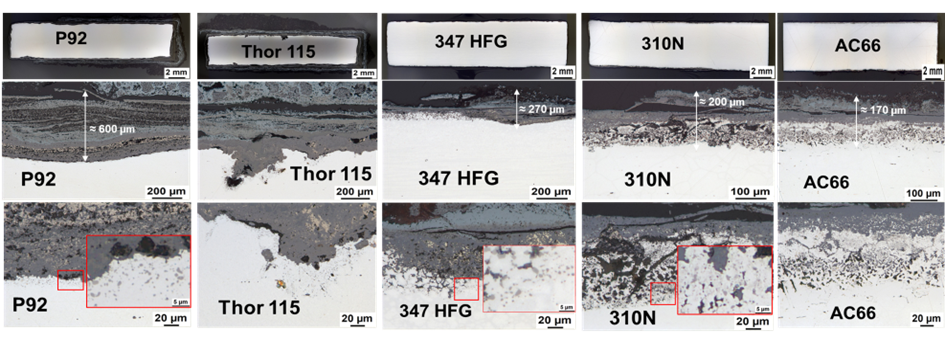
This project aims at the investigation of the prevailing corrosion mechanisms during mono-incineration of SeS at 500°C as well as its co-incineration with bituminous coal at 625°C. Isothermal corrosion tests up to 7000 h were undertaken by deep embedding different steels ranging from 9% Cr steels, e.g. P92, to high alloyed steels such as AC66 into mono- and co-incineration SSA including Ca3(PO4)2 or FePO4 and Ca5(PO4)3 in alumina crucibles. The samples were then exposed to gas atmospheres including water vapor, CO2, HCl and SO2, which are again relevant for the mono- and co-incineration of SeS. After exposure tests, water-free metallographic preparation of cross-sections, wall-thickness measurements as well as SEM and EPMA investigations were used to characterize the corrosion attack. Even though the attack is significantly aggravated by the addition of phosphates, possibly due to the formation of additional low-melting eutectic deposits, a balanced Ni/Cr content can provide sufficient protection against both chlorine-induced corrosion and sulfidation. Furthermore, Cr-rich diffusion and Cr-Si slurry coatings increased the corrosion resistance of low Cr-steels substantially, thereby enabling their application as structural materials.
backDr. Ceyhun Oskay
Tel.: +49 6172 89938-606
E-mail: ceyhun.oskay
Final Report (pdf, 17 MB, in German)